

Weapons | |
| AIRCRAFT | |
|---|---|
| Fighter | Transport |
|
A-36 Halcón
| |
| Rotary | Other |
|
Cardoen Bell 206 LIII |
T-35A Enaer T-35B Pillán T-36 Halcón |
| MISSILES | |
| Surface-to-Air | Air-to-Air |
|
| |
| Air-to-Surface | Surface-to-Surface |
|
| |
| GROUND COMBAT | |
| Tanks | Armored Vehicles |
|
|
BMS-1 Alacran VTP-1 6x6 Orca VTP-2 4x4 Escarabajo |
| Artillery | Anti-Aircraft |
|
|
|
Resources
- Cardoen Bell 206 LIII
- ARMS TO IRAQ THE CHILEAN CONNECTION By Jack Anderson and Dale Van AttaAugust 5, 1990
- IRAQ'S DEADLY ARMS NETWORK ERIC EHRMANN | Feb 19, 1991
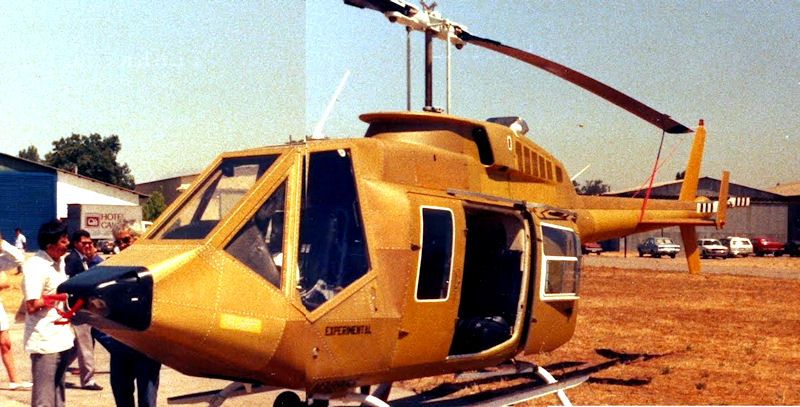
Cardoen Bell 206 LIII LongRanger
When the United States stopped selling arms to Chile due to their position on human rights, Chile was fearful that either Peru or Argentina was going to invade them. Since Chile could not buy armament from the US, the Chilean Government turned to Carlos Cardoen and asked him if he could produce mines and cluster bombs, among other explosive items.
Carlos Cardoen was an explosives expert engineer and PhD in metallurgy at the University of Utah, and president of Industrias Cardoen the largest defense manufacturer in Latin America. Gen. Augusto Pinochet, the brutal dictator of Chile, gave Carlos Cardoen his start as an international arms merchant. Iraqi President Saddam Hussein was his best customer. During the early 1980s, Mr. Hussein collaborated with authoritarian regimes in Chile, Argentina, Brazil and South Africa in their efforts to develop advanced weapons technology. Cardoen not only kept Iraq supplied with arms, but he built factories there so Iraq can make its own bombs.
In 1984 Cardoen commissioned a feasibility report from the engineer René González (doctor in aeronautical engineering at the University of Southern California). The intention: to determine the feasibility of modifying a civilian helicopter for military use. An idea that Cardoen had been considering for some time. Iraq had put in an order for 50 of the retrofitted choppers. At that time it was the German MBB BO-105 bi-turbine device. The possible benefits of the apparatus considered anti-guerrilla operations, drug traffic control and of course being able to fight and destroy armor on the ground.
The main challenge was that the helicopter selected to be redesigned was a two-seater with a high-fire exposure "bubble" cabin. This was to be replaced by a single-seater cockpit that would locate the pilot and possibly a gunner centered with respect to the longitudinal axis of the ship. The bubble cockpit had to be redesigned in such a way as to offer greater protection to the pilot and gunner both against fire from the ground (allowing the installation of armor panels) and against impact in an eventual accident. This meant a complete redesign of the cabin structure and consequently the relocation of knobs, controls, pedals, control rods, cables and redesign of the instrument panel.
Industrias Cardoen's stand at FIDA 86 was one of the most attractive at the fair. Along with all the company's fender products was the proposal to convert the BO 105 into an attack helicopter with a radically different configuration. Rocket carrier in the wing with built-in weapons, a 12.7mm Lucas turret (a replica of the turret sent by the Lucas company was installed in the mock up) and HUD (Head Up Display). An eventual possibility of offering an apparatus of considerable firepower at a fraction of the cost of much more advanced attack helicopters available at the time. If this helicopter had been developed, it would have been an excellent option for the Chilean army or others from Latin America and the third world.
But executives of the MBB (Messerschmitt - Bölkow - Blohm) during the fair refused to give the respective authorizations to go ahead with the project. Consequently, the project to build an attack helicopter was, for the time being, suspended for Industrias Cardoen.
The Bell 206 series helicopters are the most popular light helicopters in the world. These helicopters are at work on nearly every continent of the world. Airborne operations that the helicopters are used for include: VIP transport, law enforcement, medevac, petroleum exploration, geological survey, pipeline patrol, powerline patrol, search & rescue, aerial photography, and aerial survey to name a few. The helicopter’s normal cruising speed is approximately 120 MPH. The helicopter may be flown up to two hours and forty minutes before refueling. The pilot operates the helicopter from the right forward seat.
The possibility of modifying the Bell 206 L-III is considered, granting it characteristics that allow it to act as a civil aircraft (rescue, line inspections , firefighting) and as an anti-tank helicopter. On April 13, 1987, a meeting was held at the plants in Fort Worth. In which it is agreed that Bell will issue a feasibility report commissioned by Industrias Cardoen. Bell Helicopter delivered in that report a modification proposal that included a 3-view diagram, armament possibilities, avionics equipment, costs, work plan, etc. In parallel to these meetings with Bell in 1987, progress was being made in Santiago in the construction of the structural mock up and structural resistance tests of the modification designed by engineer González and built exclusively by the Industrias Cardoen "Helicopter Project" team.
Initially, a tandem cockpit (pilot and gunner) was considered for the AH (Attack Helicopter) version of the Bell 206, however it implied the displacement of the center of gravity beyond the limits that would allow an adequate behavior of the helicopter in terms of stability and control. Once this first intention has been discarded, it is decided on a single-seater cabin, placing the gunner in what was the passenger cabin. With this configuration in mind, the construction of a structural mock-up began.
René González and his team undertook the task of designing and building a wind tunnel. It was decided on a modular construction in wood considering the costs, and a configuration of the closed circuit type. Being modular, the modules could be relocated and thus function as an open circuit. It was the first time that a tunnel of such characteristics was designed and built in Chile. (In the early 1990s, the University of Santiago built a large, atmospheric-type wind tunnel, whose test section even made it possible to test cyclists on a full scale.
After meetings held in Beijing with NORINCO engineers in September 1988, a test program was agreed to be carried out in Santiago (Peldehue) in November of the same year using the structural mock up as a platform. The objective of these tests was to determine the feasibility of equipping the combat version (AH) with the anti-tank missile "Red Arrow" manufactured by NORINCO.
Once the engineering and conformity inspections were completed in Chile, the helicopter was shipped to the USA. This phase was for company flight testing, then for to obtain the STC (Supplemental Type Certificate) from the US FAA for the commercialization of the civil version of the helicopter. The FAA review is considered a seal of approval that aircraft buyers around the world -- even Iraq -- prefer to have on the merchandise they buy. The only major change to the helicopter that resulted from flight-testing was to increase the windshield thickness. The windshield deflected inward a small amount; and in rain, water would “puddle” in the center of it. To prevent this condition, the windshield thickness was increased to 7/16 inch from 3/8 inch. Both the GHI and the FAA successfully completed the flight test program. Everything was set for the FAA's issuance of the STC.
However, the FAA was not allowed to issue the STC because Iraq began its invasion of Kuwait. The President of the United States issued an Executive Order barring any US Company from doing business with Iraq. Now the story of the Cardoen helicopter project got caught up in internal intrigue and politics. The US Government believed Cardoen was selling explosives to Iraq and seized his Miami operations and impounded the helicopter project. The helicopter was sealed in a hangar on Red Bird Airport, Dallas, Texas. Cardoen Industries has denied offering the 206L helicopter to Iraq.
Jonathan Moyle, the editor of London-based Defense Helicopter World, attended the Fidae air show in Santiago in March 1990. He learned that Cardoen was planning to sell a number of Cardoen-Bell 206L modified attack helicopters equipped with guided missiles to Iraq. Moyle was found hanging in his room at the Carrera Hotel in Santiago 31 March 1990. The autopsy results revealed a tranquilizing drug in his blood. Police, however, were unable to determine if his death was a suicide or a homicide. Santiago's Radio Cooperative later reported that Moyle was murdered by agents of the Iraqi secret service.


Resources
BMS-1 Alacran
The BMS-1 Alacrán (Spanish: Scorpion) was the last halftrack combat vehicle developed. It was constructed in the early 1980s as a private venture of Cardoen Industries, based on the experience gained from the modernization of the Chilean army's M3A1 transporters, an operation that took place in the mid-1970s. The aim of the project was to develop a modern, universal combat vehicle for buyers from developing countries that still used weapons with a pedigree dating back to World War II.
The BMS-1 Alacrán is a large tonnage multipurpose vehicle, developed from the experience acquired at the end of the seventies, with the reconstruction at the request of the army of M-3 A1 semi-tracked vehicles. Cardoen created a new vehicle based on the M-3 half-track, which he named BMS-1 Alacrán. The vehicle could withstand 7.62mm impacts, piercing, in all directions, the structure includes armored sights on the sides of the vehicle so that the occupants can spindle their weapons, from inside the vehicle. The BMS-1 was equipped with a new Allison MT-653 engine and automatic transmission, reaching a maximum speed of 80 km / hr., And sustained 60 km / hr, with a range of 600 kilometers. The vehicle can house 12 fully equipped soldiers, at the same time it can be used in different configurations, such as command vehicle, antiaircraft, ambulance, antitank, porter, and could be equipped with a platform for 70mm rockets.
The main function of the vehicle was to act in desert terrain or in marshy terrain, the Chilean Army did not show interest in the vehicle given the few benefits that it presented. Ultimately, however, the BMS-1 construction program was not successful. Although the vehicle was found to be significantly more mobile than any other halftrack during trials , the Chilean military found it significantly weaker compared to fully wheeled and fully tracked vehicles, which ultimately resulted in the offer being rejected. Shortly thereafter, it turned out that there was also a shortage of foreign potential buyers who had come to conclusions similar to the Chileans and also pointed to the high price of the vehicle. However, until 1992, the BMS-1 was available from Cardoen Industries, which at that time ran into trouble with the law. It found that it had illegally sold $ 200 million in cluster bombs to Iraq, which ruined the company's reputation. Legal problems and the lack of buyers caused the BMS-1 to be withdrawn from offer.
Alacrán has a very distinctive silhouette. The front is shaped like a chisel with a steep lower section and a milder upper armor. The roof is flat and mostly devoid of protruding elements. The rear side is flat and inclined at a slight angle towards the interior of the vehicle. Also, the upper parts of the side boards are directed towards the interior of the vehicle and taper upwards. In the lower part, however, there are long, almost half the length of the vehicle, trapezoidal recesses for the tracks. The driver's seat is protected by a bulletproof windshield on the left side of the upper front armor that can be opened forwards.
The interior of the vehicle is protected by armor made of high-hardness steel, resistant to penetration by a 7.62-millimeter bullet and shrapnel from all sides, and the frontal armor has been additionally reinforced to withstand the fire of 12.7-millimeter bullets. There are no exact data, but the existing photos show that the interior of the vehicle was not lined with anti-splintering lining. It is also unknown whether the vehicle had a fire protection system and protection against ABC weapons. The BMS-1 was practically devoid of modern electronic equipment, which was limited to a radio and a passive night vision device for the driver.
Alacrán's propulsion was a Detroit Diesel 6V-53T six-cylinder diesel engine with 275hp at 2,800 rpm. The Allison MT-653 automatic transmission with five forward gears and one reverse gear was connected to the power unit. By the way, it is worth mentioning that the same engine drove the very popular American M113 armored personnel carrier. It was also possible to install another Cummins V-555 diesel engine with 230 hp at 3000 rpm. The internal tanks contained 350 liters of fuel.
The running gear was unique for the time in which the vehicle was created, and consisted of front wheels with suspension based on hydraulic coil springs and a rear track part identical to the M3A1 WW2. The suspension of the rear part was based on vertical spiral springs absorbing the trolley with four road wheels mounted on two axles. The lineage of this suspension system can be traced back to the American tanks of the Second World War: the M2, M3 Lee and the M4 Sherman. In addition, the system consisted of one wheel supporting the tracks at the top, a large front idler wheel, and a rear drive wheel. The tracks themselves remained unchanged from the M3A1.
The BMS-1 was 6.37 meters long, 2.36 meters wide and 2.3 meters high. The combat weight was 10.5 tons, which gave a pressure of 0.71 kg / cm2. The maximum climbable angle was 60%, and the lateral tilt was 40%. The vehicle was able to wade in water up to 1.6 meters deep. However, data specifying the machine's ability to overcome ditches and vertical obstacles is not available.
Standard armament in the armored personnel carrier version did not differ from the then standards in this class. At the commander's hatch it was possible to install a 12.7 millimeter M2HB machine gun, a 7.62 millimeter rifle, a 40 millimeter grenade launcher or a recoilless rifle. As an armored personnel carrier, the BMS-1 could take ten landing men, each with an individual seat. On the side boards there were four, and on the rear two openings for fire from the inside. The soldiers were able to exit the vehicle through two rectangular hatches placed in the ceiling and opening to the right side of the door in the rear side. Sapper tools were placed outside the vehicle, in front of the port side.


VTP-1 Orca 6x6 APC
The VTP-1 Orca is an all-wheeled version of the BMS-1 Alacran, in a 6x6 configuration based on a "commercial truck chassis". At the time of development, the VTP-1 Orca was the largest and heaviest wheeled armored personnel carrier. What is remarkable about the Orca armored personnel carrier as it is the largest passenger capacity among modern BTR, as well as its size and weight. It was designed with the aim of providing the Chilean army with a universal high-cross transporter, which could quickly transport a large number of people, weapons and equipment over long distances.
The development of VTP-1 Orca began at the beginning of 1980s, and the project was officially announced in 1983. The Orca BTR was developed in parallel with the semi-tracked BMS-1 Alacran Halftrack armored personnel carrier, using a large number of mechanical and structural elements and therefore these machines have a close external similarity.
The VTP-1 was a 6 x 6 multirole armored vehicle that could serve as a troop transport and performr assault and reconnaissance tasks. The VTP-1 had a front-mounted engine with air-inlet louvers at the top and bottom to allow access to the engine for maintenance. The driver was located to the rear of the engine on the left, with the commander to their right. The vehicle had an open-top troop compartment at the rear of the hull, and entry and exit is through two rear doors.
The VTP-1 ORCA had frontal protection against 7.62mm ammunition or 0.50 caliber machine gun fire. Developed according to the philosophy of low cost and high efficiency, it employed the basis of a standard 6 x 6 vehicle chassis. It had a liquid-cooled diesel engine and an automatic transmission. With six wheels and wide tires, the ORCA can be used in difficult terrain for a wide variety of missions: transporting up to 16 fully equipped soldiers or 5 tons of material to support armored battalions, it can be used as a tank vehicle or equipped with a 120 mm mortar.
The version of the armored personnel carrier is equipped with a commander turret with a sliding installation for the 7,62-mm MAG machine gun, the M12,7HB 2-mm or the Mk.19 automatic grenade launcher. The corps can also receive heavy weapon systems (for example, a turret with an automatic cannon), although in this case a turret with weapons is excluded. The landing force can fire through two embrasures with viewing devices in the sides and one in the aft door.
The thickness of the armor of the alloy steel body varies from mm 6 to mm 16, which was said provides protection against explosions on mines, shell splinters and 7,62 mm armor piercing bullets. It is not known whether the machine had an anti-splinter lining, a system for protecting against weapons of mass destruction, or a fire extinguishing system.
The crew is located in front, the rear troop compartment takes up more than half the length of the car. The driver sits on the left, the car commander on the right, while the paratroopers sit on the sides of the car facing each other. There are two rectangular hatches in the middle of the machine, located closer to the sides and opening to the outside. There is one hinged door in the stern. BTP VTP-1 Orca currently has the largest troop compartment among the mass-produced wheeled armored personnel carriers.
Like most of the combat vehicles produced by developing countries, the electronics of the Orca BTR is rather modest. The radio station is standard, the driver’s night-vision periscope is optionally installed, but it is known that other optical and electronic components were offered for the car.
The BTP VTP-1 Orca is equipped with a six-cylinder Detroit Diesel 6V53T diesel engine with an 275 hp power, coupled with an Allison MT653DR automatic transmission with 5 front and 1 reverse gear. The maximum speed of the machine is 120 km / h, the maximum power reserve of 1200 km. The fuel tank capacity is 400 liters of diesel fuel. The suspension, according to some information, is taken from a civilian truck, but there are no more details on it. The VTP-1 Orca armored personnel carrier does not float.
In addition to its primary role of troop transport, the manufacturer has proposed the vehicle for a number of other roles including towing a 105mm or 155mm artillery weapon as well as carrying its crew and ammunition, 20 to 30mm air-defence weapon, 60 to 90mm direct fire weapon, anti-tank with ATGWs, mortar carrier with 120mm mortar that can be traversed through 360 deg. together with ammunition and crew, ammunition resupply vehicle, radar carrier to provide air-defence weapons with an early warning capability, command vehicle with a crew of 12+2, vehicle mounted communications relay station, mobile workshop, ambulance carrying up to 12 injured men, mobile hospital carrying an inflatable unit and a mobile emergency surgery.
It was completely developed by Cardoen, only two prototypes were manufactured, but it is said that some units were manufactured in series from 1986. It is not known whether the Orca BTR was in service, but according to some sources, the Chilean army ordered 100 vehicles in the 1985 year, and an order for a smaller number was issued by the Chilean marine corps. Production of this machine is currently impossible.
The Chilean Army did not show interest, given the poor performance that the vehicle demonstrated in difficult terrain.
| Configuration | 6 x 6 |
| Combat weight | 18 000 kg |
| Unloaded weight | 13 000 kg |
| Length | 7,84 m |
| Width | 2,5 m |
| Height | 2,5 m |
| Armor | 6 mm - 16 mm |
| weapons | 1 x 12,7-mm machine guns (~ 600 shots) |
| Mobility | |
| Engine | V6 Detroit Diesel 6V53T water-cooled diesel |
| Power | 260 HP at 2800 rpm |
| Top speed | 120 km / h |
| Fuel capacity | 400 litres |
| Max. range | 1000 km |
| Transmission | automatic, 5 forward and 1 reverse gears |
| Tires | 14.00 x 20 |
| Maneuverability | |
| Slope | 60% |
| Side slope | 30% |
| Vertical scarp | ~ 0,6 m |
| Trench | 0,6 ~ 1 m |
| Broad | ~ 1,5 m |
| Crew | 2 people |
| Landing | 16 people |


VTP-2 4x4 Escarabajo
The VTP-2 4x4 Escarabajo is an armored hull mounted on a UNIMOG chassis. Cardoen VTP-2 is a Chilean armored car designed for use as an armored personnel carrier, command-staff ambulance, and repair vehicle. The car was developed in accordance with the requirements of the Chilean Air Force, but lost in the competition to an armored car of a similar purpose, developed at the Makina firm.
The hull has a weight of 2.5 and 3.3 tons depending on the armor. The vehicle weighs 6,600 kg, empty with lighter armor and 5,800 kg with heavy armor. Its load capacity varies between 1,400 kg for the first and 2,000 kg for the second. Its maximum weight at flat load is 8,000 kg. The vehicle could withstand 7.62mm, armor-piercing impacts. The structure includes armored sights on the sides of the vehicle. In the front part and in the two side doors it has larger armored glasses, which can also be reinforced by folding armored plates, for cases in which heavy fire must be faced. The vehicle can house 12 fully equipped soldiers, at the same time it can be an employer in different configurations, such as command vehicle, anti-aircraft, anti-tank, porter, etc.
The body of the VTP-2 armored car is welded, made of steel armor plates 6-8 mm thick. On the sides, next to the commander's and driver's seats, there are small forward-opening doors with bulletproof glass windows. The front of the hull has one large bulletproof glass window. The windows in the doors can be covered with armored dampers. For firing personal weapons in the sides there are three embrasures and three observation devices, two more embrasures are in the aft armor plate. The fighting compartment is accessed through a door at the rear of the vehicle and through two rectangular hatches in the roof. In the roof, behind the commander's and driver's seats, there is a round hatch, next to which a machine gun can be installed, or a rotating tower can be mounted instead of the hatch.
Variants of armored personnel carriers were developed with turrets armed with 20 and 25 mm automatic cannons, a 12.7 mm machine gun, and coaxial 20 mm anti-aircraft guns. A variant of the armored personnel carrier with an open top of the fighting compartment was being tested. The engine compartment is located in the front part of the body in a small ledge. The armored structure can be adapted with various types of armaments from 7.62mm immediate defense machine guns to anti-tank wire-guided missiles.
The engine uses DIESEL N2 oil, it has tanks of 150 liters with a performance of 4 km / liters. Engine six-cylinder water-cooled diesel engine Daimler-Benz BD-OM 352 with a power of 88 kW. The Daimler Benz Diesel engine allows it a power-to-weight ratio of 15 HP / Ton., Enough for its operation in all terrain. The engine is water-cooled, operates a conventional synchronized manual transmission gearbox, 8 forward and 4 reverse gears , with dry single-disc clutch. Disc brakes are installed on all four wheels, Hutchinson tires are 12.5x20. The front wheels are steered, the hydraulic booster is included in the control circuit. The armored car is equipped with a filter-ventilation system; a slight overpressure is maintained inside the body.
| Measures | |
| Total length | 5,370 mm. |
| Total width | 2,320 mm. |
| Total height | 2,220 mm |
| Interior height | 440 mm. |
| Performaces | |
| Maximum speed | 100 km / hr |
| Maximum sustained speed | 85 km / hr |
| Maximum climb | 70% |
| Maximum lateral incline | 35% |
| Minimum turning circle | 12.9 mts. |
| Autonomy | 600 km |
| Empty weight | 5,800 and 6,600 kg |
| Payload | 1,200 and 2,000 kg |
| Maximum weight | 8,000 kg |
| Relac. weight power | 15 HP / ton |
| Cap. Fuel | 150 liters |
| Engine and Transmission | |
| Make | Daimler Benz |
| Model | Diesel BD-OM 352 |
| No. of cylinders | 6 in line. |
| Cylinder diameter. | 97 mm. |
| Conventional Gearbox | synchronized 8 forward 4 reverse gears. |
| Front-wheel drive | Connectable and disconnectable in motion. |
| Differential lock | On both axes, connectable on the move |
| Wheels | Hutchinson bulletproof type |
| Quantity | 4 units |
| Tire size | 12.5 x 20 |
| Tire size | 11 x 20 |
| Brake Systems | Disc to all four wheels and mechanical hand to the rear wheels. |
| Steering systems | Servo Hydraulics |
| Electric systems | Battery 2 x 12 volts. |
| Voltage capacity | 24v / 110 A / hour |


|
NEWSLETTER
|
| Join the GlobalSecurity.org mailing list |
|
|
|
