

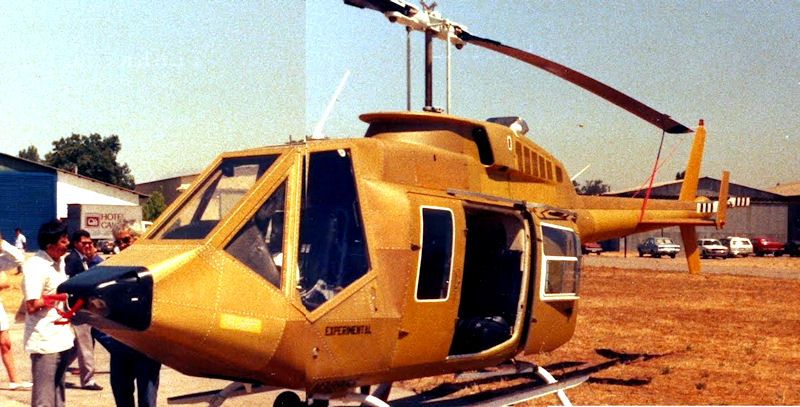
Cardoen Bell 206 LIII LongRanger
When the United States stopped selling arms to Chile due to their position on human rights, Chile was fearful that either Peru or Argentina was going to invade them. Since Chile could not buy armament from the US, the Chilean Government turned to Carlos Cardoen and asked him if he could produce mines and cluster bombs, among other explosive items.
Carlos Cardoen was an explosives expert engineer and PhD in metallurgy at the University of Utah, and president of Industrias Cardoen the largest defense manufacturer in Latin America. Gen. Augusto Pinochet, the brutal dictator of Chile, gave Carlos Cardoen his start as an international arms merchant. Iraqi President Saddam Hussein was his best customer. During the early 1980s, Mr. Hussein collaborated with authoritarian regimes in Chile, Argentina, Brazil and South Africa in their efforts to develop advanced weapons technology. Cardoen not only kept Iraq supplied with arms, but he built factories there so Iraq can make its own bombs.
In 1984 Cardoen commissioned a feasibility report from the engineer René González (doctor in aeronautical engineering at the University of Southern California). The intention: to determine the feasibility of modifying a civilian helicopter for military use. An idea that Cardoen had been considering for some time. Iraq had put in an order for 50 of the retrofitted choppers. At that time it was the German MBB BO-105 bi-turbine device. The possible benefits of the apparatus considered anti-guerrilla operations, drug traffic control and of course being able to fight and destroy armor on the ground.
The main challenge was that the helicopter selected to be redesigned was a two-seater with a high-fire exposure "bubble" cabin. This was to be replaced by a single-seater cockpit that would locate the pilot and possibly a gunner centered with respect to the longitudinal axis of the ship. The bubble cockpit had to be redesigned in such a way as to offer greater protection to the pilot and gunner both against fire from the ground (allowing the installation of armor panels) and against impact in an eventual accident. This meant a complete redesign of the cabin structure and consequently the relocation of knobs, controls, pedals, control rods, cables and redesign of the instrument panel.
Industrias Cardoen's stand at FIDA 86 was one of the most attractive at the fair. Along with all the company's fender products was the proposal to convert the BO 105 into an attack helicopter with a radically different configuration. Rocket carrier in the wing with built-in weapons, a 12.7mm Lucas turret (a replica of the turret sent by the Lucas company was installed in the mock up) and HUD (Head Up Display). An eventual possibility of offering an apparatus of considerable firepower at a fraction of the cost of much more advanced attack helicopters available at the time. If this helicopter had been developed, it would have been an excellent option for the Chilean army or others from Latin America and the third world.
But executives of the MBB (Messerschmitt - Bölkow - Blohm) during the fair refused to give the respective authorizations to go ahead with the project. Consequently, the project to build an attack helicopter was, for the time being, suspended for Industrias Cardoen.
The Bell 206 series helicopters are the most popular light helicopters in the world. These helicopters are at work on nearly every continent of the world. Airborne operations that the helicopters are used for include: VIP transport, law enforcement, medevac, petroleum exploration, geological survey, pipeline patrol, powerline patrol, search & rescue, aerial photography, and aerial survey to name a few. The helicopter’s normal cruising speed is approximately 120 MPH. The helicopter may be flown up to two hours and forty minutes before refueling. The pilot operates the helicopter from the right forward seat.
The possibility of modifying the Bell 206 L-III is considered, granting it characteristics that allow it to act as a civil aircraft (rescue, line inspections , firefighting) and as an anti-tank helicopter. On April 13, 1987, a meeting was held at the plants in Fort Worth. In which it is agreed that Bell will issue a feasibility report commissioned by Industrias Cardoen. Bell Helicopter delivered in that report a modification proposal that included a 3-view diagram, armament possibilities, avionics equipment, costs, work plan, etc. In parallel to these meetings with Bell in 1987, progress was being made in Santiago in the construction of the structural mock up and structural resistance tests of the modification designed by engineer González and built exclusively by the Industrias Cardoen "Helicopter Project" team.
Initially, a tandem cockpit (pilot and gunner) was considered for the AH (Attack Helicopter) version of the Bell 206, however it implied the displacement of the center of gravity beyond the limits that would allow an adequate behavior of the helicopter in terms of stability and control. Once this first intention has been discarded, it is decided on a single-seater cabin, placing the gunner in what was the passenger cabin. With this configuration in mind, the construction of a structural mock-up began.
René González and his team undertook the task of designing and building a wind tunnel. It was decided on a modular construction in wood considering the costs, and a configuration of the closed circuit type. Being modular, the modules could be relocated and thus function as an open circuit. It was the first time that a tunnel of such characteristics was designed and built in Chile. (In the early 1990s, the University of Santiago built a large, atmospheric-type wind tunnel, whose test section even made it possible to test cyclists on a full scale.
After meetings held in Beijing with NORINCO engineers in September 1988, a test program was agreed to be carried out in Santiago (Peldehue) in November of the same year using the structural mock up as a platform. The objective of these tests was to determine the feasibility of equipping the combat version (AH) with the anti-tank missile "Red Arrow" manufactured by NORINCO.
Once the engineering and conformity inspections were completed in Chile, the helicopter was shipped to the USA. This phase was for company flight testing, then for to obtain the STC (Supplemental Type Certificate) from the US FAA for the commercialization of the civil version of the helicopter. The FAA review is considered a seal of approval that aircraft buyers around the world -- even Iraq -- prefer to have on the merchandise they buy. The only major change to the helicopter that resulted from flight-testing was to increase the windshield thickness. The windshield deflected inward a small amount; and in rain, water would “puddle” in the center of it. To prevent this condition, the windshield thickness was increased to 7/16 inch from 3/8 inch. Both the GHI and the FAA successfully completed the flight test program. Everything was set for the FAA's issuance of the STC.
However, the FAA was not allowed to issue the STC because Iraq began its invasion of Kuwait. The President of the United States issued an Executive Order barring any US Company from doing business with Iraq. Now the story of the Cardoen helicopter project got caught up in internal intrigue and politics. The US Government believed Cardoen was selling explosives to Iraq and seized his Miami operations and impounded the helicopter project. The helicopter was sealed in a hangar on Red Bird Airport, Dallas, Texas. Cardoen Industries has denied offering the 206L helicopter to Iraq.
Jonathan Moyle, the editor of London-based Defense Helicopter World, attended the Fidae air show in Santiago in March 1990. He learned that Cardoen was planning to sell a number of Cardoen-Bell 206L modified attack helicopters equipped with guided missiles to Iraq. Moyle was found hanging in his room at the Carrera Hotel in Santiago 31 March 1990. The autopsy results revealed a tranquilizing drug in his blood. Police, however, were unable to determine if his death was a suicide or a homicide. Santiago's Radio Cooperative later reported that Moyle was murdered by agents of the Iraqi secret service.


|
NEWSLETTER
|
| Join the GlobalSecurity.org mailing list |
|
|
|
