

Dream Chaser
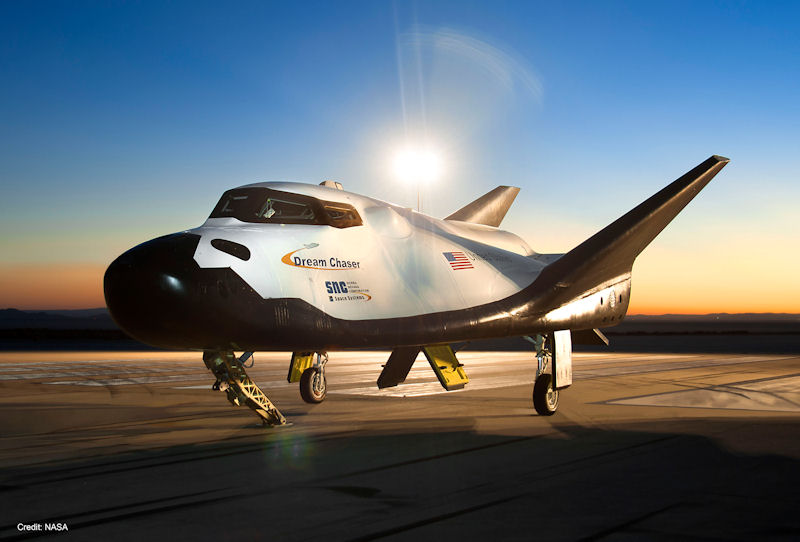
 The Dream Chaser is a revival of NASA's HL-20 Personnel Launch System lifting-body design. The Dream Chaser Space System is designed to be optionally piloted and transport up to seven crew members and cargo to LEO destinations with a gentle return to a runway landing. The Dream Chaser spacecraft is 30 feet, or 9 meters, long which is roughly ¼ the total length of the Space Shuttle orbiters. The spacecraft can carry the same crew size as the Space Shuttle and can remain docked to the ISS considerably longer.
The initial focus of the SpaceDev Advanced Systems group is an overall space transportation system based on the NASA HL-20 lifting body spaceplane. Christened the Dream ChaserTM, it is being designed to carry passengers and cargo in the sub-orbital and orbital flights regimes, including flights to and from the International Space Station. Leveraging the work performed on the NASA HL-20, the Dream ChaserTM will provide a safe and affordable solution for commercial space operations, will launch vertically and land horizontally on conventional runways.
As of December 31, 2006, SpaceDev's executive officers and directors together beneficially owned approximately 45.7% of the issued and outstanding shares of our common stock. James W. Benson and Susan C. Benson beneficially own approximately 22% of SpaceDev common stock. Mr. Benson separated from SpaceDev's employ in September 2006 and founded Benson Space Company but retains a seat on our Board of Directors. In October 2006, SpaceDev was awarded a $330,000 Phase I study contract from Benson Space Company to further the SpaceDev Dream ChaserT spaceship program. The study contributed to the on-going development of the spaceship and resulted in space vehicle and rocket motor designs ready for Phase II vehicle fabrication and testing. The SpaceDev Dream ChaserT spaceship is based on NASA's design of the ten passenger orbital HL-20 Personnel Launch System, and will launch vertically and land horizontally. SpaceDev recognized approximately $76,000 in revenue under this contract from inception through December 31, 2006.
SpaceDev is currently working in conjunction with NASA Commercial Orbital Transporation Services (COTS) office to develop and configure the system for ISS servicing. In parallel, SpaceDev has signed a memorandum of understanding with United Launch Alliance (ULA) and is evaluating man-rating the Atlas 5 launch vehicle and configuring it for use with Dream ChaserTM to provide a launch configuration based on the exceptional heritage of the Atlas family of launch vehicles.
Marketing and sales expenses increased to approximately $2.2 million, or 6.8% of net sales, for the year ended December 31, 2006, from approximately $674,000, or 7.5% of net sales, during the same period in 2005. The total dollar increase of approximately $1.5 million was mainly due to costs related to bidding a number of proposals, including approximately $800,000 for the NASA COTS proposal during 2006, as well as absorbing a larger marketing and sales organization as part of the merger with Starsys. Unfortunately, SpaceDev did not win the COTS contract.
On June 19, 2014 Sierra Nevada Corporation (SNC), headquartered in Sparks, Nevada, announced that it has signed a definitive purchase agreement to acquire the Orbital Technologies Corporation (ORBITEC) as a wholly-owned subsidiary of SNC. ORBITEC is a leading subsystems integrator and high technology development company based in Madison, Wisconsin. ORBITEC's strong liquid rocket propulsion, life science and support, and fire suppression technology portfolio will enhance both SNC Space Systems' Propulsion and Spacecraft Systems' product lines.
. ORBITEC is the lead for the Environmental Control and Life Support Systems (ECLSS) and Thermal Control Systems (TCS) for SNC, providing reliable living conditions including temperature and humidity control to support the astronauts during their journeys on SNC's Dream Chaser® spacecraft. Recently, SNC selected ORBITEC to provide the RCS engines for Dream Chaser using green, nontoxic propellants.
SpaceDev has begun designing a reuseable, piloted, sub-orbital space ship that could be scaled to transport passengers to and from Low Earth Orbit, including the International Space Station. The name of the vehicle is the SpaceDev Dream ChaserT. SpaceDev signed a non-binding Space Act Memorandum of Understanding with NASA Ames Research Center, which confirmed SpaceDev's intention to explore novel, hybrid propulsion based hypersonic test beds for routine human space access. SpaceDev will explore with NASA collaborative partnerships to investigate the potential of using SpaceDev's proven hybrid propulsion and other technologies, and a low cost, private space program development approach to establish and design new piloted small launch vehicles and flight test platforms to enable near-term, low-cost routine space access for NASA and the United States.
Unlike the more complex SpaceShipOne, for which SpaceDev provided critical proprietary hybrid rocket motor propulsion technologies and components, the SpaceDev Dream ChaserT would be crewed and launch vertically, like most launch vehicles, and would glide back for a normal horizontal runway landing. The sub-orbital SpaceDev Dream ChaserT would have an altitude goal of approximately 160 km (about 100 miles) and would be powered by a single, high performance hybrid rocket motor, under parallel development by us for the SpaceDev StreakerT, a family of small, expendable launch vehicles, designed to affordably deliver small satellites to Low Earth Orbit. The SpaceDev Dream ChaserT motor would produce approximately 100,000 pounds of thrust, about six times the thrust of the SpaceShipOne motor, but less than one-half the thrust of the 250,000 pounds of thrust produced by hybrid rocket motors developed several years ago by the American Rocket Company.
On September 29, 2004 and October 4, 2004, SpaceDev's hybrid propulsion technology helped propel SpaceShipOne into space flight history as the craft garnered the $10 Million Ansari X Prize, a contest created to stimulate the development of the private sector human space flight industry. SpaceDev provided several critical components and the hybrid rocket technology for the craft's motor, including igniter, injector and main operating valve, which successfully performed as expected and powered SpaceShipOne on its historic manned flight. SpaceShipOne exceeded the altitude requirement on both scheduled flights as required by the Ansari X Prize competition. The hybrid propulsion system burned full duration and pilot Brian Binnie steered SpaceShipOne high above the Mojave, California desert to a height of 367,442 feet altitude (69.5 miles), which far exceeded the required 328,000 feet altitude - a sky-high goal required by the X Prize Foundation of St. Louis, Missouri.
SpaceDev, Inc., including wholly-owned active subsidiary, Starsys, Inc., which was acquired by SpaceDevs on January 31, 2006, is engaged in the conception, design, development, manufacture, integration, sale and operation of space technology systems, subsystems, products and services, as well as the design, manufacture, and sale of mechanical and electromechanical subsystems and components for spacecraft. We are currently focused on the commercial and military development of low-cost small satellites and related subsystems, hybrid rocket propulsion for space and launch vehicles, subsystems that enable critical spacecraft functions such as pointing solar arrays and communication antennas and restraining, deploying and actuating moving spacecraft components.
The acquisition of Starsys on January 31, 2006 fundamentally changed the SpaceDev profile. Starsys was insolvent at the time of the merger. SpaceDev's historic business had 2005 revenues of approximately $9.0 million and a 2005 profit of approximately $0.5 million. Starsys is a mature operating company with 2005 revenues of approximately $18 million and 2005 losses of approximately $3.4 million. In 2006, SpaceDev and Starsys merged and had combined revenues of approximately $32 million and losses of less than $1.0 million.
During 2006, approximately 89% of net sales were generated from direct government contracts, and from government-related work through subcontracts with others, while the remaining 11% was generated from commercial contracts. In 2005, approximately 98% of net sales were generated from direct government contracts and from government-related work through subcontracts with others, while the remaining 2% was generated from commercial contracts. The mix shift was primarily due to the January 2006 acquisition of Starsys.
In 2009, SNC acquired SpaceDev Inc. Other accounts related that in 2008, SNC acquired SpaceDev, an aerospace and defense industry company. Read more: http://www.digitaljournal.com/tech-and-science/technology/sierra-nevada-s-dream-chaser-to-fly-first-un-mission-in-2021/article/476025#ixzz4ix9HP0tg SNC's reusable Dream Chaser spacecraft is a multi-mission, commercial, lifting-body vehicle capable of transportation services to low-Earth orbit (LEO) destinations, including the International Space Station (ISS). SNC has developed one common Dream Chaser spacecraft airframe, which we call a Space Utility Vehicle (SUV) due to its mission flexibility. However, there are currently two Dream Chaser variants optimized specifically for either uncrewed or crewed missions, known as the Dream Chaser Cargo System and Dream Chaser Space System, respectively. Additional variants may be developed for future mission needs.
The Dream Chaser Spacecraft Airframe Features Include:
- Lifting-body spacecraft with the same outer mold line (shape)
- Capable of autonomous launch, flight and landing (does not require a pilot)
- High reusability
- Low 1.5 g atmospheric entry throughout the entire flight profile
- Gentle runway landing on any compatible commercial runway, both in the United States and internationally
- Immediate access to crew or cargo upon landing
- All non-toxic consumables, including propellants - a historic first!
- Ability to perform an ISS propulsive reboost when docked (lifts ISS to a higher orbital altitude)
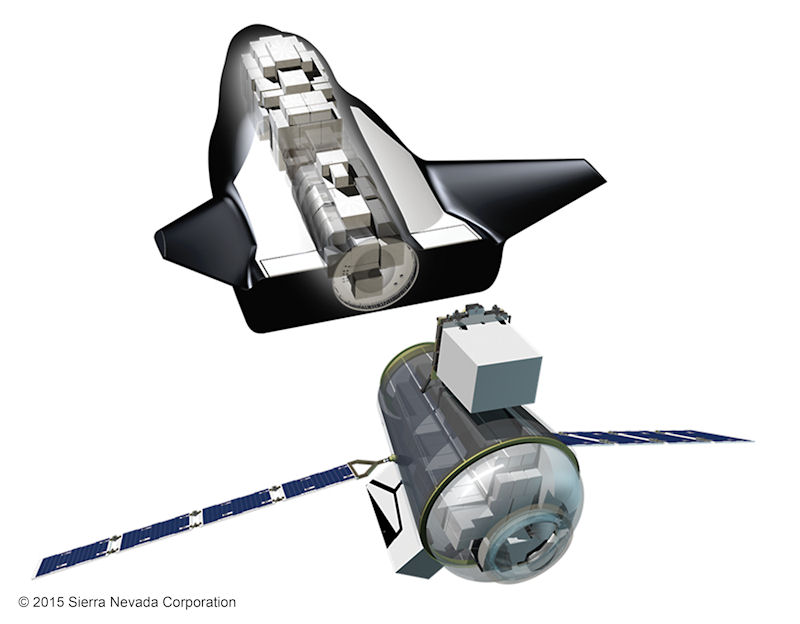
The Dream Chaser Cargo System is designed to deliver up to 5,500 kg of pressurized and unpressurized cargo to the ISS with the ability to conduct orbital disposal services and responsively return pressurized cargo at less than 1.5 g’s to a gentle runway landing. This solution meets or exceeds NASA’s current cargo transportation requirements.
Addition of an environmental control, life support system and seating capable of transporting a crew of seven and critical cargo to LEO. Launches without a fairing, on top of a human-rated United Launch Alliance Atlas V rocket with the ability to safely abort to a runway in the event of an emergency
SNC’s Dream Chaser spacecraft has been in development for more than 10 years, including six years as part of NASA’s Commercial Crew Program, and leverages more than 40 years of X-vehicle and NASA space shuttle heritage. To date, SNC has received funding from NASA and has made its own significant investments to mature the Dream Chaser vehicle. SNC’s Dream Chaser spacecraft leverages over 40 years of NASA X-vehicle and Space Shuttle heritage.
With Boeing and SpaceX receiving the coveted commercial crew transportation contracts in September 2014 to ferry NASA astronauts to and from the International Space Station (ISS) beginning in 2017, Sierra Nevada Corporations’ Dream Chaser (DC) space plane was left out in the cold.
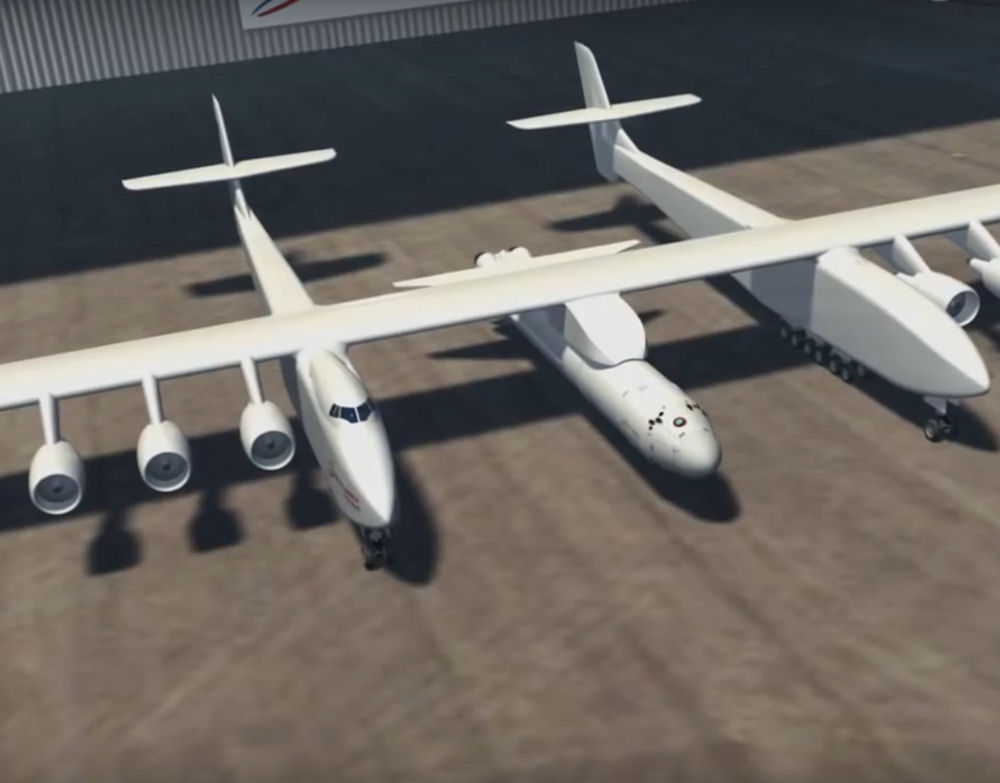 According to am October 2014 study document released by Vulcan Aerospace Corporation and SNC, the companies “have collaborated on a space transportation architecture, utilizing the Stratolaunch aircraft as a launch platform and the Dream Chaser spacecraft as the payload.” In this configuration, DC would be a 75 percent sized variant of the DC spacecraft designed as part of NASA’s crew transportation contract program. As noted in the study document, “even with a smaller scale, the scale DC can achieve a comparable mission length to the commercial crew variant." n total, the scaled version of DC would be 22.5 feet in length, contain a fin tip-to-tip wingspan of 18.2 feet, be able to carry a maximum of two crewmembers to ISS and three crewmember LEO (Low Earth Orbit) destinations.
On January 14, 2016 NASA competitively selected Sierra Nevada Corporation’s (SNC) Space Systems to receive a multi-year contract to provide cargo delivery, return and disposal services for the International Space Station (ISS). SNC received a Commercial Resupply Services 2 (CRS2) contract, to fulfill a minimum of six cargo delivery service missions to and from the ISS utilizing SNC’s Dream Chaser Cargo System. NASA’s selection of SNC for the CRS2 program will enable spacecraft reusability and runway landings for United States’ cargo delivery and access to the ISS through 2024.
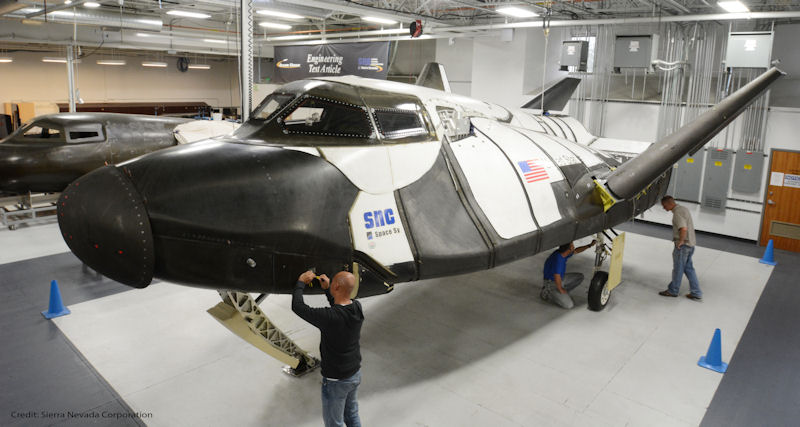
By July 2016 the Dream Chaser full-scale, flight test vehicle was ready for transportation to NASA’s Armstrong Flight Research Center (AFRC) in California where Phase Two flight tests will be conducted in coordination with Edwards Air Force Base (AFB). Dream Chaser program upgrades and initial hardware testing were completed at the Louisville, Colorado spacecraft assembly facility, and within the next several weeks the same Dream Chaser vehicle that conducted Phase One flight testing will arrive at NASA’s AFRC. Upon arrival, SNC will begin a series of pre-flight ground evaluations to verify and validate the vehicle’s system and subsystem designs. After successful completion of all ground testing, Dream Chaser will begin its Phase Two free-flight testing. These activities are being conducted through a Space Act Agreement with NASA’s Commercial Crew Program (CCP).
The vehicle will undergo a series of tests building on those performed in Phase One, including tow-tests, pre-flight tests and ending with free-flight testing. SNC is also performing additional critical tests to validate the Dream Chaser’s orbital flight software and calculate the spacecraft's handling and performance characteristics. Along with other pre-flight and post-flight evaluations, this data will be used to confirm Dream Chaser’s subsonic aerodynamic properties as well as flight software and control system performance requirements.
Sparks, Nevada-based Sierra Nevada Corp. (SNC) is a privately-held company that was formed in 1963. Sierra Nevada Corporation provides customer-focused technology solutions in the areas of aerospace, aviation, electronics and systems integration. SNC has been honored as one of “The World’s Top 10 Most Innovative Companies in Space,” and one of America’s fastest growing companies. SNC’s Space Systems business area based in Louisville, Colorado, designs and manufactures advanced spacecraft, space vehicles, rocket motors and spacecraft subsystems and components for the U.S. Government, commercial customers, as well as for the international market. SNC has more than 25 years of space heritage, participating in more than 450 successful space missions and delivering 4,000+ systems, subsystems and components around the world.
Under the leadership of CEO Fatih Ozmen and President Eren Ozmen, SNC has a workforce of over 3,000 personnel in 30 locations in 16 states. SNC's six unique business areas are dedicated to providing solutions to SNC's customer base.
|
NEWSLETTER
|
| Join the GlobalSecurity.org mailing list |
|
|
|
